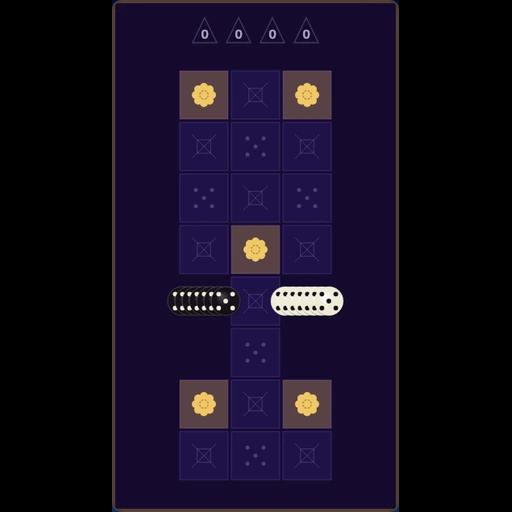
Royal Game of Ur — A 4,500-Year-Old Race Through the Stars
One of the oldest board games ever discovered, unearthed from the Royal Tombs of Ur in ancient Mesopotamia. Roll the dice, race your pieces across the shared middle lane, capture your opponent’s stragglers, and land on a rosette for another turn.
Choosing a Ruleset
Serious modern reconstructions of Ur genuinely disagree with each other, so four are offered here rather than picking just one. All four are sourced and credited via royalur.net/rules — the mechanics themselves aren’t copyrightable, only their specific text and art, so everything here is built independently.
Finkel (default)
Irving Finkel's British Museum reconstruction — the most commonly played version today: 7 pieces, 4 dice, rosettes safe and worth an extra roll.
Masters
James Masters' alternative path: rosettes every 4th square, 3 dice, rosettes not safe. Rolling 0 moves you 4 squares instead of forfeiting.
Blitz
Masters path with only 5 pieces. Captures grant an extra roll on top of rosettes — games can swing hard on a single lucky turn.
Tournament Engine
Used at real SIU tournaments. Rosettes safe but no extra roll; backward moves allowed (or skip); pieces can stack on rosettes and move as one.
How to Play
Roll
Click Roll at the start of your turn. Binary dice are thrown (4 for Finkel/Blitz/Tournament, 3 for Masters); your roll is how many landed marked-side-up.
Move
Click one of your pieces to move it exactly that many squares along your path — from hand, through private squares, across the shared row, then off.
Capture & Rosettes
Landing on an opponent sends them back to hand — unless the square is a safe rosette (depends on ruleset). Rosettes may grant another roll immediately.
Bear Off & Win
Roll the exact number needed to bear a piece off. First player to bear off all pieces wins (7 under Finkel/Masters, 5 under Blitz/Tournament).
Captain Tips
Fight for the Middle Rosette
Under any ruleset where rosettes are safe, the shared row's rosette is the most valuable square on the board.
Don't Bunch Up
A piece on an unsafe shared square is one good roll away from being sent home.
Race Pieces Home
Pieces already borne off can never be captured — get them off once you're ahead.
Watch Tournament Stacks
In Tournament Engine, capturing a stacked rosette sends back two or more pieces at once.
History
The board was excavated by Leonard Woolley in the 1920s from the Royal Cemetery at Ur (southern Iraq), dating to roughly 2600–2400 BCE. The rules come from a Babylonian cuneiform tablet (~177 BCE), translated by Irving Finkel in the 1980s — roughly 2,400 years after the boards were buried.
That gap is why Bell, Finkel, Masters, Murray, and Skiriuk disagree on finer details. Finkel’s rosette placement (4th, 8th, 14th squares) matches most digital versions today; Masters, Blitz, and Tournament Engine are three other real, actively played reconstructions.
Why Play Royal Game of Ur?
Ancient Strategy
Dice luck meets tactical piece placement — a race game with real decisions every turn.
Mobile Ready
Tap to roll and move. Portrait board and touch-friendly controls sized for phones and tablets.
Always Free
Play vs AI or pass-and-play on the same device. No downloads, ads, or paywalls.
Frequently asked questions
- Is Royal Game of Ur free to play?
- Yes. Play in your browser — no downloads, registration, or payments required.
- Can I play on mobile?
- Yes. Tap Roll, then tap a piece to move. The portrait board and HUD are sized for phones and tablets.
- Which ruleset should I start with?
- Finkel is the default and most widely played reconstruction. Try Masters or Blitz for faster variants, or Tournament Engine for the tournament ruleset.
- Can I play with a friend?
- Yes. Choose 2 Players mode for local pass-and-play on the same device.