Choose your side
Senet — The Game of Passing
New: Learn to play step by step in the new Senet, which also lets you choose other scholars’ rules and plays with a keyboard or screen reader. Open the new Senet.
One of the oldest known board games — Senet boards and pieces have been found in Egyptian graves dating back to roughly 3100 BCE, predating the Royal Game of Ur. No rulebook survives from antiquity. This build follows Timothy Kendall’s 1978 reconstruction (Passing Through the Netherworld: The Meaning and Play of Senet, an Ancient Egyptian Funerary Game), the version multiple independent sources point to as the most established modern reading of the evidence.
How to Play
Goal — Be the first to bear all 7 of your pieces off the far end of the board.
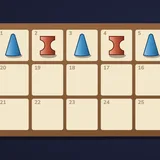
Board — 30 squares in an S-shaped path: left-to-right along the top row, right-to-left along the middle row, left-to-right along the bottom row.
Setup — Pieces start already on the board, alternating along squares 1–14. Cone moves first.
Throwing — Click Throw Sticks. Four sticks are thrown; your move is the number landing marked-side-up (1–4), or 5 if none do.
Movement — Click a highlighted square to move a piece there. A piece may not move past square 26 (Happiness) until it has landed there at least once. Three or more of your opponent’s pieces in a row block you completely — you can’t land on or pass through them.
Swapping — Landing on a single opposing piece swaps the two pieces’ positions, sending theirs backward to where yours came from. You can’t land on your own piece.
The five special squares:
- 15 — Rebirth: the starting/14th square, and where pieces bounced from square 27 land again.
- 26 — Happiness: every piece must land here at some point on its way around.
- 27 — Water: landing here sends the piece back to square 15 (or the nearest empty square before it).
- 28 — Three Truths and 29 — Re-Atoum: documented as needing an exact roll to leave (3 and 2 respectively).
Bearing off — A piece leaves the board only on an exact roll to square 31 — no overshooting. This one rule is what produces the documented “28 needs a 3, 29 needs a 2” restrictions, and extends the same logic to squares 26 and 30 without treating them as separate special cases.
No legal move — If none of your pieces can legally move with the roll you threw, your turn is skipped.
A note on two rules
Two mechanics aren’t spelled out precisely enough by any source found to implement without a judgment call, and are flagged here rather than presented as settled fact:
- Bearing off is implemented as “exact landing on square 31 only, from any square” — this isn’t a separate rule invented for this build, it’s the single mechanic that already reproduces the documented restrictions on squares 28 and 29 as a direct consequence, extended consistently to the whole endgame rather than special-casing each square.
- Square 26’s “mandatory for all pawns” is implemented as a checkpoint: a piece can’t move to a square past 26 until it has landed on 26 at least once. This is a reasonable reading of the source material, not a directly documented mechanic.
History
Senet (“passing” or “passage”) appears in Egyptian art as early as the Third Dynasty, and a painted relief of Queen Nefertari playing Senet survives in her tomb at the Valley of the Queens (13th century BCE). Over time the game took on funerary significance — a Senet board was among the objects found in Tutankhamun’s tomb, and the journey across the board came to be associated with the deceased’s passage through the afterlife, guided past dangers (like the House of Water) toward rebirth.
Pick as many as you like. Games must match one choice from each group you use.
Board Games
Classic and cosmic board challenges — think ahead, outmaneuver the AI.






Card Games
Patience and planning with a stellar deck.

Puzzle
Match, clear, and chase the next satisfying combo.












Arcade
Quick reflex runs — high scores welcome.


Pick as many as you like. Games must match one choice from each group you use.
Board Games
Classic and cosmic board challenges — think ahead, outmaneuver the AI.
Card Games
Patience and planning with a stellar deck.
Puzzle
Match, clear, and chase the next satisfying combo.
Arcade
Quick reflex runs — high scores welcome.